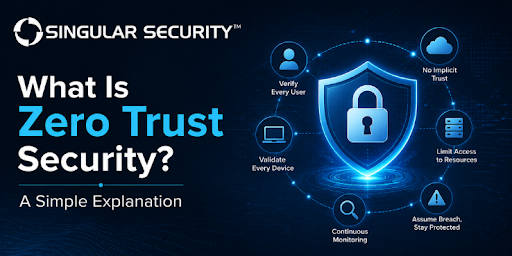
The speed of cyber threats exceeds the capability of current security systems to protect against them. Companies that depend on perimeter security systems have created significant vulnerabilities that hackers exploit every day. Zero trust cyber security requires all access points to eliminate all implicit trust while demanding ongoing user and device, and system verification.
“Did you know? The core idea behind Zero Trust is that no user or device should ever be implicitly trusted is deliberately designed to eliminate the old “castle-and-moat” mentality in cybersecurity.”
Key Takeaways
- The Zero Trust security model requires users to provide multiple identity proofs before they can access any system resources.
- Users receive only essential access rights, which helps reduce risks that arise from credential breaches.
- Network segmentation stops attackers from accessing different systems after they have gained initial entry through a security breach.
- The security operations center uses real-time threat detection together with artificial intelligence analytics to decrease the time that attackers stay undetected in the system.
At Singular Security, our Identity and Access Management, Continuous Monitoring, and platform services and vCISO advisory work together to create zero trust cyber security solutions. The Zero Trust model provides nine effective methods for preventing cyber attacks, which Singular Security implements to protect your business.
1. Enforcing Strict Identity Verification at Every Access Point
The Cyber Security Zero Trust framework requires users to prove their identity before they receive system access. The Identity and Access Management service by Singular Security implements multi-factor authentication together with role-based access controls to protect your organization, which permits only authorized personnel to access protected systems and information. The IAM service from Singular Security requires users to prove their identity through user authentication before they can access any system or data.
- Multi-factor authentication stops attackers from accessing your critical business systems through the use of stolen login credentials.
- Role-based access controls restrict employees from accessing resources that do not directly support their work duties.
- The system monitors access in real time to detect both suspicious login attempts and unauthorized access activities throughout all operational environments.
- Access rights undergo continuous policy enforcement, which requires organizations to assess and modify access rights whenever employee roles or security threats change.

2. Applying Least-Privilege Access to Minimize Attack Surface
The Cyber Security Zero Trust framework establishes its fundamental principle, which requires organizations to provide users with only essential access rights. The IAM and vCISO services of Singular Security work together to establish and maintain constant assessments of least-privileged access control,s which decreases the available paths for attackers to breach security.
- The organization uses least-privilege policies to safeguard its systems from potential damage that might result from a single account being compromised.
- The vCISO team at Singular Security conducts regular audits of access rights to your organization by canceling access permissions that present security risks to your organization.
- Automated access reviews through the system identify privilege creep problems, which must be fixed before they create dangerous situations.
- The organization limits administrative access to only those personnel who have been verified, which helps to decrease the possibility of insider threats and credential-based attacks.
- IAM enforcement requires all vendors and contractors to maintain the same access control requirementsthath internal staff members must follow.
3. Implementing Network Micro-Segmentation to Contain Breaches
Zero trust network security uses micro-segmentation to divide your network into isolated zones, preventing attackers from moving freely after an initial breach. The Continuous Monitoring service by Singular Security implements permanent boundary protection, which identifies and contains threats before they can expand.
- The implementation of network segmentation prevents unauthorized access to adjacent systems and sensitive information through automatic system breaches that occur in one zone.
- The security operations center employees at Singular Security monitor all segment boundaries, which enables them to detect any unauthorized entry attempts and respond promptly.
- The network infrastructure maintains complete separation between critical systems and general network traffic, which includes financial data and customer records.
- The combination of micro-segmentation and threat hunting methods provides a substantial reduction in the extent of damage that an attacker can cause through successful breaches.
- The platform provides your team with complete visibility of existing exposure risks by mapping out the locations of segmentation gaps.
4. Continuous Monitoring to Detect Threats in Real Time
The implementation of Zero Trust network security requires continuous surveillance. The service of Continuous Monitoring and Advanced Threat Protection provided by Singular Security operates its 24×7 Security Operations Center to monitor all endpoints, networks, and cloud systems for real-time threat detection.
- The 24×7 Security Operations Center monitoring system provides complete security by detecting all unauthorized access attempts throughout your entire network infrastructure.
- AI-based threat detection systems recognize unusual user behavior patterns that standard signature-based security systems fail to detect.
- Singular Security’s analysts provide expert triage support, separating real threats from noise to reduce alert fatigue.
- The monitoring of cloud environments enables organizations to implement Zero Trust security measures throughout their hybrid and multi-cloud systems.
- The organization uses rapid threat response methods, which reduce attacker dwell time, preventing attackers from operating undetected within their systems.
5. Stopping Lateral Movement Before It Escalates
Once hackers gain access to a network,k they use lateral movement techniques to obtain higher access rights,s which allow them to target valuable assets. The zero trust model cybersecurity framework is built to stop this. The security operations center team of Singular Security uses EDR/XDR/MDR tools to detect and stop lateral movement before it can create major damage.
- EDR/XDR/MDR tools flag unusual endpoint behavior that indicates an attacker is attempting to move laterally.
- Singular Security’s SOC analysts isolate compromised endpoints in real time, cutting off attacker movement paths immediately.
- The organization uses identity verification at every internal access point to block attackers from accessing multiple accounts through a single compromised account.
- Threat hunting activities search for hidden attackers who have already entered your network and remain undetected.
- vCISO incident response planning enables your team to respond with quick and effective measures when lateral movement detection occurs.

6. Strengthening Cloud Security with Zero Trust Principles
The increase in cloud adoption has substantially expanded the number of potential attack points. The zero trust model cybersecurity framework extends protection into cloud environments by applying the same verify-first approach to every cloud access request. The Continuous Monitoring service from Singular Security protects both cloud and hybrid and on-premises systems through its single unified security system.
- The organization uses identity verification methods together with least-privilege access controls to handle all cloud access requests, which require the same security measures as their on-site systems.
- Singular Security operates its 24-hour monitoring system to track cloud environments, which enables the company to identify security breaches through real-time detection of system vulnerabilities.
- The platform enables organizations to monitor their entire cloud and on-premises systems through unified visibility, which prevents any operational areas from becoming invisible.
- The Compliance Readiness services validate your cloud security controls against NIST, HIPAA, and other relevant regulatory requirements.
- The vCISO advisory service creates a cloud security plan that implements Zero Trust security measures throughout all architectural components of your system.
7. Using Security Awareness Training to Eliminate Human Risk
The primary reason successful cyber attacks happen is because of human mistakes. The Security Awareness Training and Testing service provided by Singular Security teaches employees how to identify phishing attacks, social engineering techniques, and other security threats, which helps your company build a protective base through its Zero Trust security system.
- The company conducts regular phishing tests to measure employee knowledge and determine which employees require more customized security training.
- Training programs focus on teaching employees about the three most commonly used methods that attackers use to execute ransomware attacks, social engineering attacks, and credential theft.
- Security Awareness Testing helps organizations track their progress by demonstrating to management how their staff members have decreased risk over time.
- Employees who receive training in Zero Trust principles establish better protection measures for sensitive information, which leads to fewer data breaches through accidental exposure.
- A security-aware culture strengthens every technical control by decreasing the number of entry points that attackers use to gain access to systems.
8. Achieving Compliance Through Zero Trust Policy Frameworks
The process of regulatory compliance depends on the implementation of Zero Trust security measures. The Compliance Readiness service from Singular Security helps your organization establish zero trust network security policies that comply with NIST, HIPAA, GLBA, and other standards while maintaining effective security protection.
- Singular Security establishes a direct connection between your Zero Trust controls and the NIST, HIPAA, and GLBA compliance standards.
- The platform streamlines the process of compliance crosswalks, which enables your team to spend less time on audit preparation work.
- The organization maintains its compliance status through policy enforcement, which updates the compliance status whenever regulations or business operations undergo changes.
- vCISO advisory services deliver governance, risk management, and compliance assistance,e which keeps your executive team up to date and ready for any situation.
- The process of demonstrating Zero Trust compliance creates trust between your organization and its clients, partners, and regulators who assess your security measures.
9. Proactive Threat Hunting to Stay Ahead of Attackers
Waiting for alerts is not sufficient. The SOC team at Singular Security performs active threat detection throughout your entire system to find signs of security breaches before hackers can launch their attacks. The active security measures of this organization create a distinction between Cyber Security Zero Trust systems,s which operate in active defense mode and those which function in defensive response mode.
- SOC threat hunters search through standard network traffic to find hidden attacker tactics, techniques, and procedures that attackers use.
- The analysts at Singular Security utilize advanced intelligence data streams to detect new threats that specifically target your industry.
- Proactive hunting discovers security breaches through credential theft and hidden malware, and unauthorized system entry,y which automated systems fail to detect.
- The results of threat hunting investigations provide essential information that your vCISO security team uses to create an ongoing security enhancement plan.
- Your leadership team receives real-time reports about changes in the threat landscape, together with details on how Singular Security is managing those threats.
Build Your Zero Trust Defense
Cyber attacks will continue to occur, but your organization can achieve successful defense through proper strategic implementation. Singular Security Inc. provides your business with essential Zero Trust security solutions.
Our services implement zero-trust cybersecurity throughout all components of your system to provide you with complete control over current security challenges. The existing security system needs assessment because waiting for a breach to occur will reveal its existing security weaknesses.
Also Read This Blog:-
Frequently Asked Questions
Q1. What does Zero Trust mean in the field of cybersecurity?
The Zero Trust security framework operates according to its fundamental rule, which states that entities should not receive trust from users until their identity has been verified. The system requires complete authentication and authorization, plus ongoing validation for all access requests.
Q2. What methods does Zero Trust use to stop cyber attacks?
The system blocks threats through its implementation of multiple security measures,s which include multi-factor authentication, least-privilege access, network micro-segmentation, continuous monitoring, and active threat detection. The security system creates two protection layers that prevent unauthorized access and decrease potential damage from security breaches.
Q3. Do only large companies have access to Zero Trust security?
Zero Trust security systems provide advantages to organizations that exist at every business level. The security system protects small and mid-sized businesses, which face high cyberattack risk,s through its flexible protection, which adapts to their organizational growth.
Q4. What operational process does Zero Trust use in cloud computing environments?
Zero Trust establishes identical identity verification requirements and least-privilege access rules for both cloud systems and on-premise network environments. The security system continuously monitors hybrid and multi-cloud environments to maintain security during all operational periods.
Q5. Does Zero Trust assist organizations in meeting their compliance obligations?
The system establishes access controls through its monitoring functions and documented security protocols to support compliance with NIST, HIPAA, GLBA, and additional regulatory standards.